ASUS vs Ist Computers: Gaming Laptops Compared by Specs
As an Amazon Associate we earn from qualifying purchases. Links on this page are affiliate links.
When comparing the ASUS vs ist computers gaming laptop options, you see two distinct 16-inch machines. Both feature 16GB of RAM and 512GB of storage. The primary difference lies in their architecture. The ASUS model uses a Qualcomm Snapdragon X processor with integrated Adreno graphics. The Ist Computers option relies on an Intel Core 5 120U with Intel Graphics. These choices define their respective performance profiles.
Key differences
| Aspect | ASUS Vivobook 16 Snapdragon Laptop | Ist Computers Dell Pro 16 Laptop |
|---|---|---|
| Processor | Qualcomm Snapdragon X | Intel Core 5 120U |
| Graphics Card | Qualcomm Adreno GPU | Intel Graphics |
| Memory Type | 16GB | 16GB DDR5 |
| Operating System | Windows 11 Home | Windows 11 Pro |
| Weight | 3.88 pounds | 4.23 pounds |
Which one should you choose?
Choose ASUS Vivobook 16 Snapdragon Laptop if
- You prioritize battery life and AI processing capabilities
- You want a lighter device for easier portability
- You prefer the Snapdragon ecosystem for power efficiency
Choose Ist Computers Dell Pro 16 Laptop if
- You need Windows 11 Pro for enterprise features
- You require Thunderbolt 4 and extensive connectivity ports
- You value MIL-STD-810H durability for rugged use
Verdict: The ASUS Vivobook 16 suits users seeking efficiency and a lighter form factor. The Ist Computers Dell Pro 16 is better for professionals needing robust connectivity and professional-grade software features. Choose based on whether you prioritize mobility or business functionality.
ASUS vs Ist Computers: Spec Breakdown
Processor
The ASUS Vivobook 16 uses a Qualcomm Snapdragon X 8-core processor with an integrated Hexagon NPU rated at up to 45 TOPS. This architecture is designed for AI tasks and power efficiency, aiming for multi-day battery life. In contrast, the Ist Computers Dell Pro 16 features an Intel Core 5 120U processor with 10 cores and speeds up to 5.0 GHz. This is a traditional x86 architecture. The Intel chip offers higher raw clock speeds and core counts, which typically benefits heavy desktop workloads. The Snapdragon focuses on efficiency and AI acceleration rather than peak raw performance per clock cycle.
Graphics Card
For graphics, the ASUS Vivobook 16 relies on the Qualcomm Adreno GPU. This is an integrated solution using Qualcomm's sliced-architecture design to balance performance and power consumption for everyday visuals and light gaming. The Ist Computers Dell Pro 16 uses Intel Graphics, which are also integrated into the Core 5 120U processor. Both systems lack dedicated discrete graphics cards. Neither machine is equipped with a high-end GPU for intensive 3D rendering or modern AAA gaming. You should expect similar baseline visual performance for web browsing and media consumption, as both rely on integrated silicon rather than separate graphics hardware.
Display
Both laptops share identical display specifications regarding resolution and size. The ASUS Vivobook 16 offers a 16-inch WUXGA screen with a 1920 x 1200 resolution and a 60Hz refresh rate. The Ist Computers Dell Pro 16 also provides a 16-inch WUXGA panel at 1920 x 1200. Both screens deliver 300 nits of brightness. The ASUS model highlights brilliant colors, while the Dell model emphasizes an anti-glare coating and narrow borders. Since the resolution, size, and refresh rate are the same, neither display offers a technical advantage over the other for visual clarity or smoothness.
Memory and Storage
In terms of capacity, both machines are matched. The ASUS Vivobook 16 comes with 16GB of RAM and a 512GB SSD. The Ist Computers Dell Pro 16 also includes 16GB of RAM and 512GB of storage. However, there is a technical difference in the memory type. The Dell model specifies DDR5 RAM, which is generally faster and more efficient than the standard RAM found in many Snapdragon-based systems, though the exact type for the ASUS is not explicitly detailed beyond 16GB. Both use PCIe SSDs for storage, ensuring fast load times for applications and games on both devices.
Connectivity
The Ist Computers Dell Pro 16 offers significantly more robust connectivity options. It includes Thunderbolt 4, USB-C, USB-A, HDMI 2.1, an Ethernet RJ45 port, and Wi-Fi 6E with Bluetooth 5.3. This setup supports external displays up to 4K and provides wired networking. The ASUS Vivobook 16 data does not list specific port types or wireless standards. While Snapdragon devices often include Wi-Fi and Bluetooth, the absence of listed Thunderbolt 4 or Ethernet ports on the ASUS suggests the Dell has a clear advantage for users needing versatile peripheral connections or wired internet access.
Which gaming laptop suits your needs
Users wanting long battery life and AI tasks
The ASUS Vivobook 16 uses a Qualcomm Snapdragon X processor designed for power efficiency and multi-day battery life. Its Hexagon NPU handles AI tasks with up to 45 TOPS. This architecture prioritizes endurance and seamless connectivity, making it ideal for mobile workflows that require sustained performance without frequent charging.
Professionals needing robust connectivity and enterprise features
The Ist Computers Dell Pro 16 offers Thunderbolt 4, HDMI 2.1, and Ethernet for versatile connectivity. It supports up to three external monitors and includes Windows 11 Pro with BitLocker encryption. This model suits users who require reliable wired connections, advanced security, and the ability to expand their workspace significantly.
Buyers prioritizing portability and lightweight design
The ASUS Vivobook 16 weighs 3.88 pounds, making it lighter than the Ist Computers option. Its dimensions and weight make it easier to carry during daily commutes or travel. If you value a lighter machine that still provides 16GB of RAM and a 16-inch display, this is the practical choice.
The products compared

ASUS Vivobook 16 Snapdragon Laptop
Best for: Productivity and AI-focused mobile work
- Graphics Card
- Qualcomm Adreno GPU
- Processor
- Qualcomm Snapdragon X
- Memory
- 16GB
- Storage Capacity
- 512GB SSD
- Screen Size
- 16"
- Refresh Rate
- 60Hz
View on Amazon: ASUS Vivobook 16 Snapdragon Laptop Affiliate link
The ASUS Vivobook 16 pairs a 16-inch WUXGA display with a Qualcomm Snapdragon X processor and 16GB of RAM. You get a 60Hz refresh rate and 512GB of SSD storage. This laptop targets users who prioritize battery life and AI performance over raw gaming power. It suits those who need a portable machine for daily tasks and light creative work.
Pros
- Qualcomm Snapdragon X processor with Hexagon NPU for AI tasks
- 16GB RAM supports smooth multitasking
- 16-inch WUXGA display with 300-nit brightness
- 512GB PCIe 4.0 SSD for fast storage
Cons
- Integrated Qualcomm Adreno GPU limits heavy gaming
- 60Hz refresh rate is standard for productivity
- 3.88-pound weight adds bulk for travel
Good fit if
- You need all-day battery life from the Snapdragon X chip
- You want a large 16-inch screen for productivity
- You prioritize AI processing capabilities
Skip if
- You require dedicated graphics for high-end gaming
- You need a high-refresh-rate display for fast motion
- You prefer an Intel or AMD processor ecosystem
Verdict: ASUS Vivobook 16 Snapdragon X fits users who value efficiency and screen real estate over dedicated graphics performance.
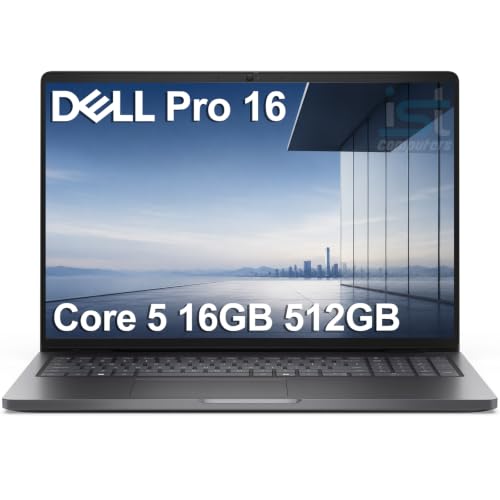
Ist Computers Dell Pro 16 Laptop
Best for: Office multitasking and professional workflows
- Graphics Card
- Intel Graphics
- Processor
- Intel Core 5 120U
- Memory
- 16GB DDR5
- Storage Capacity
- 512GB PCIe SSD
- Screen Size
- 16"
- Display Resolution
- 1920x1200
View on Amazon: Ist Computers Dell Pro 16 Laptop Affiliate link
The Ist Computers Dell Pro 16 pairs an Intel Core 5 120U processor with 16GB of DDR5 RAM. It features a 16-inch WUXGA display with anti-glare coating and 512GB of PCIe SSD storage. This configuration supports multitasking and rapid application loading. It suits professionals needing a portable machine for office workflows or field work. The build passes MIL-STD 810H tests for durability.
Pros
- Intel Core 5 120U processor with up to 5.0 GHz speed
- 16GB DDR5 RAM for efficient multitasking
- 16-inch WUXGA (1920x1200) anti-glare display
- Thunderbolt 4 and HDMI 2.1 connectivity
- Windows 11 Pro with enterprise security features
Cons
- Integrated Intel Graphics limits gaming performance
- 512GB SSD storage is smaller than higher-tier options
- 4.23-pound weight adds bulk for travel
Good fit if
- You need Windows 11 Pro for work
- You require Thunderbolt 4 connectivity
- You want a durable, portable laptop
Skip if
- You need dedicated graphics for gaming
- You require 32GB or more RAM
- You prefer a lighter ultrabook
Verdict: Ist Computers Dell Pro 16 fits office workers who need Windows 11 Pro and Thunderbolt 4 ports. It avoids gamers who need dedicated graphics cards.
Specifications side by side
| Spec | ASUS Vivobook 16 Snapdragon Laptop | Ist Computers Dell Pro 16 Laptop |
|---|---|---|
| Graphics Card | Qualcomm Adreno GPU | Intel Graphics |
| Processor | Qualcomm Snapdragon X | Intel Core 5 120U |
| Memory | 16GB | 16GB DDR5 |
| Storage Capacity | 512GB SSD | 512GB PCIe SSD |
| Screen Size | 16" | 16" |
| Refresh Rate | 60Hz | not stated |
| Display Resolution | 1920 x 1200 WUXGA | 1920x1200 |
| Storage | 512GB SSD | 512GB SSD |
| Use | not stated | Business |
| Dimensions | 2.5 × 12 × 19 inches | 14.1 × 9.91 × 0.82 inches |
| Weight | 3.88 pounds | 4.23 pounds |
| Size | 2.50 | 16GB|512GB |
| Color | Quiet Blue | Magnetite |
| Model | X1607QA-DS54 | Dell pro 16 |
Frequently asked questions
Can I use the ASUS Vivobook 16 for serious gaming?
No, this model is not built for serious gaming. It relies on integrated Adreno graphics rather than a dedicated graphics card. The Snapdragon X processor prioritizes efficiency and AI tasks over raw graphical power. You should look for a device with a discrete GPU if you need high frame rates in modern titles.
Does the Ist Computers Dell Pro 16 have a dedicated graphics card?
No, this laptop avoids dedicated graphics cards. It is designed for office workers and professional workflows that do not require heavy graphical processing. The system focuses on Windows 11 Pro features and Thunderbolt 4 connectivity instead of gaming performance or high-end visual rendering capabilities.
Which laptop is heavier to carry around?
The Ist Computers Dell Pro 16 is heavier. It weighs 4.23 pounds, while the ASUS Vivobook 16 weighs 3.88 pounds. Both machines are portable, but the Ist model is slightly bulkier. You should consider this weight difference if you plan to carry your device in a bag daily.
What is the screen size for these two laptops?
Both laptops feature a 16-inch display. The ASUS Vivobook 16 offers 16 inches of screen real estate for productivity tasks. The Ist Computers Dell Pro 16 also provides a 16-inch panel. You get the same visual space on both devices for multitasking and media consumption.
Do both laptops come with 16GB of RAM?
Yes, both systems include 16GB of RAM. This memory amount supports multitasking and running multiple applications simultaneously. The ASUS Vivobook 16 and the Ist Computers Dell Pro 16 share this specification. You will have sufficient memory for general productivity and professional workflows on either machine.
Is the storage capacity the same on both devices?
Yes, both laptops are equipped with a 512GB SSD. This storage size provides adequate space for your operating system, applications, and personal files. The ASUS and Ist models offer identical storage specifications. You will not need to upgrade storage immediately for standard use cases.
Which laptop is better for AI-focused mobile work?
The ASUS Vivobook 16 is better for AI-focused work. It uses a Snapdragon X processor with a Hexagon NPU rated at up to 45 TOPS. This architecture is designed for efficiency and AI tasks. The Ist Computers model lacks this specific AI hardware focus and is intended for standard office use.